


SUMMARY
A new APS-supported study of ten years of NTSB accident data reveals the leading causes of fatal accidents across personal, instructional, and other general aviation operations, highlighting the significant role of Loss of Control In-flight (LOC-I).
Let the Data Speak: A BROADER LOOK AT GENERAL AVIATION SAFETY
Which types of aviation accidents occur most frequently, and which are associated with the greatest loss of life?
The answers are not always the same.
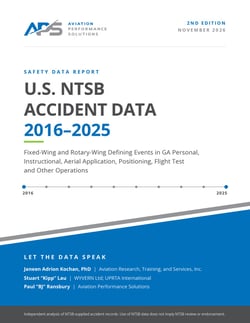
Building on the first edition focused on business aviation, the new report, U.S. NTSB Accident Data 2016–2025: Fixed-Wing and Rotary-Wing Defining Events in GA Personal, Instructional, Aerial Application, Positioning, Flight Test and Other Operations, extends the analysis to additional general aviation operations.
The independent study examines NTSB-supplied accident records from 2016 through 2025, analyzing airplanes and helicopters separately. It ranks defining events by fatalities, fatal accidents, and total accidents to provide a clearer picture of where recorded outcomes are concentrated.
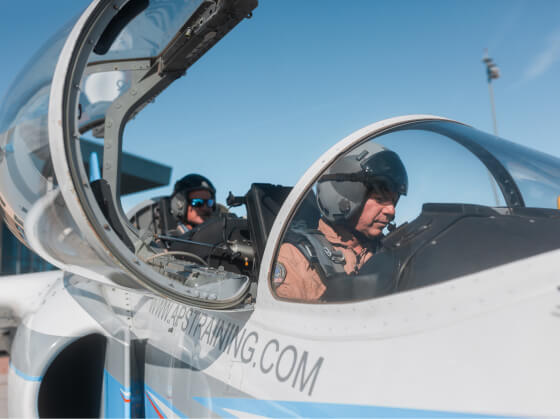
APS is making this research available to pilots, flight instructors, flight schools, aviation safety professionals, industry organizations, and researchers seeking data-driven insights into general aviation safety.
Full Report Link: DOWNLOAD HERE
What the Report Shows
Across the fixed-wing operations analyzed, Loss of Control In-flight (LOC-I) accounts for 44% of recorded fatalities, despite representing just 15% of accidents.
The findings highlight several important distinctions:
- Personal flying: LOC-I accounts for 46% of fixed-wing fatalities, making it the leading defining event by fatalities in this category.
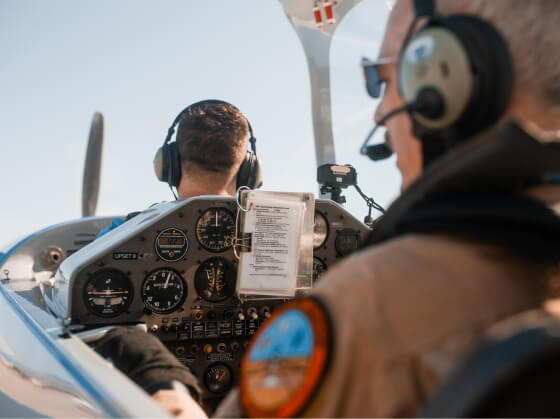
- Flight instruction: LOC-I accounts for 47% of fixed-wing instructional fatalities, underscoring its significance even in operations dedicated to pilot training.
- Accident frequency versus severity: Loss of Control on Ground leads total accidents across the analyzed fixed-wing operations at 19%, but accounts for just 1% of fatalities.
- Aerial application: Low Altitude Operation, rather than LOC-I, leads fatalities in both fixed-wing and rotary-wing aerial application operations.
- Helicopter operations: LOC-I accounts for 24% of fatalities across the analyzed rotary-wing operations, with different patterns emerging by type of operation.
These findings reinforce an important distinction: the events that happen most often are not necessarily those associated with the greatest human consequences.
The 72-page report includes detailed findings by type of operation, comparative charts, full lookup tables, and documented methodology and limitations.
The analysis describes recorded outcomes, not underlying causes or the effectiveness of specific safety interventions. Percentages represent shares of recorded accidents or fatalities, not accident rates adjusted for flight activity.
Expanding the Aviation Safety Research
This second edition extends the methodology established in the October 2026 business aviation study, which examined GA Business, Executive/Corporate, and Part 135 On-Demand operations.
Together, the two reports provide complementary perspectives on defining events across distinct segments of aviation, allowing readers to examine how accident patterns and fatal outcomes differ by aircraft category and type of operation.
Read the First Edition: NTSB Accident Analysis, Business Aviation 2016–2025
Independent Research, APS Support
The study was authored by Janeen Adrion Kochan, PhD; Stuart “Kipp” Lau; and Paul “BJ” Ransbury.
Using NTSB-supplied accident records and a documented, repeatable methodology, the authors analyzed defining events across the included operations. The report provides supporting data tables, methodological assumptions, and reconciliation checks to support transparency and future research.
The NTSB supplied the underlying accident records. Use of those records does not imply NTSB review, approval, or endorsement of the analysis.
Download the Report
Read the findings, examine the charts and explore the methodology behind the analysis.