


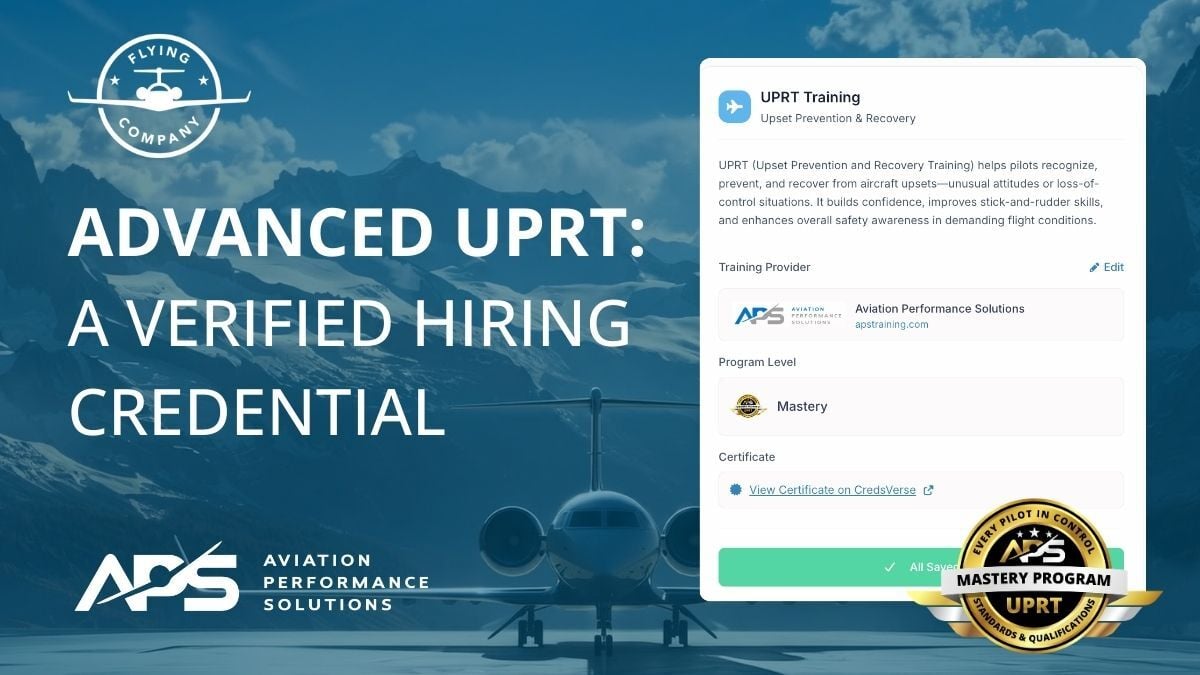
Bentonville, AR and Mesa, AZ — Flying Company announced today a new enhancement to its pilot resume platform that allows pilots to display verified Upset Prevention and Recovery Training (UPRT) credentials from Aviation Performance Solutions (APS).
The new field enables pilots to link directly to their APS certifier URL, giving flight departments and operators immediate visibility into whether a pilot has completed advanced UPRT aligned with the industry’s Every Pilot In Control Solution Standard™ for upset training.
The result: one of aviation’s most differentiating safety-critical skills is now easy to see, verify, and factor into hiring decisions.
How This Helps Aviation Hiring Managers
Loss of Control In-flight (LOC-I) remains the leading cause of fatal aviation accidents worldwide. As awareness of this risk grows and more data is released on the efficacy of UPRT, the training is increasingly recognized as a key indicator of a pilot’s ability to manage rare, high-consequence situations as well as day-to-day flying.
Yet until now, UPRT has often been difficult to identify or compare on a resume.
“Flight hours and type ratings are important, but they don’t tell the whole story,” said Flying Company CEO Tyler Flagg. “This integration helps operators quickly identify pilots who have invested in advanced training that directly impacts safety and operational resilience. It’s a powerful signal of professionalism and competency."
By surfacing verified UPRT credentials directly in pilot profiles, Flying Company makes it easier for organizations to find and hire exceptional pilots with greater confidence.
A Competitive Advantage for Pilots—and a Better Fit for Everyone
For pilots, the integration offers a meaningful way to stand out in a competitive market—without self-promotion or ambiguity. Displaying verified APS UPRT credentials signals a commitment to excellence, preparation, and continuous improvement.
For operators and flight departments, it provides a clearer path to identifying pilots whose training aligns with their safety culture and operational expectations.
“This UPRT visibility is about better matches on both sides,” said APS CEO Paul ‘BJ’ Ransbury. “Pilots with advanced UPRT are often seeking organizations that value skill, discipline, and safety, and Flying Company makes those connections easier to make.”
By integrating advanced UPRT visibility into its hiring workflow, Flying Company continues to raise the standard for how pilots are evaluated, moving beyond basic qualifications toward skills that matter most.
About Flying Company
Flying Company is a professional services marketplace built specifically for business aviation. It enables flight departments to staff their aircraft internally by providing a single platform to find, assess, hire, and pay pilots. Designed to reduce administrative burden and improve transparency, Flying Company gives operators greater control over staffing while helping pilots connect directly with operators and showcase their qualifications in a professional, structured format.
About Aviation Performance Solutions (APS)
Aviation Performance Solutions (APS) is a global leader in Upset Prevention and Recovery Training (UPRT), recognized for its specialized expertise in Jet UPRT for professional pilots. Dedicated to mitigating Loss of Control In-flight (LOC-I), aviation’s leading cause of fatalities, APS delivers a fully integrated training system combining academics, on-aircraft instruction, advanced simulation, and virtual reality.
Trusted by airlines, business aviation operators, military organizations, and corporate flight departments worldwide, APS’s UPRT methodology has been validated through independently verified research demonstrating significant improvements in pilots’ upset recognition, recovery performance, and resilience to startle and surprise in real-world training environments.